Your company has grown, business processes have become more complex, you are entering international markets, but your old website still looks like an e-business card from 2015? Find out what a modern corporate portal is, how integration with CRM and sophisticated B2B modules can reduce operating costs by 30%, and why professional development is the fastest way to outperform your competitors.

Signs that your current website is holding your company back
Most companies face a paradox: their offline business runs like clockwork, the sales department closes complex deals, but their digital presence is hopelessly out of step with the company’s actual status. If an investor, major dealer, or top specialist visits your site and sees chaos—you’re losing money. Reputational damage in the B2B segment costs millions.
Here are 5 signs that you urgently need to develop a new website:
- Managers are acting as a “help desk.” Instead of closing deals, they spend hours answering routine questions, sending price lists in PDF format, and explaining delivery terms.
- The website doesn’t generate organic traffic. Your site can’t be found on Google for commercial queries because its structure doesn’t meet search engine requirements.
- Lack of mobile optimization. By 2026, over 70% of B2B traffic will come from smartphones. If the site looks messy on a phone screen, the customer will close the tab within 3 seconds.
- Zero integration. Leads arrive via email (and are often lost) rather than being automatically routed to your CRM system (Salesforce, Pipedrive, Zoho).
- Difficulty scaling. To add a new service or language version, you have to hire a programmer and wait for weeks because the website is built on an outdated, custom-coded “engine.”
What is a modern corporate website, really?
A corporate website is a large-scale, multifunctional web resource that serves as the official digital representation of a medium or large business on the internet. Unlike ordinary business cards, its architecture is designed not only for presentation but for deep integration into the company’s business processes.
It is a full-fledged digital office. It operates 24/7 without days off, sick leave, or burnout. A modern corporate website serves as the best sales manager, HR director, and PR specialist all at once.
How a corporate website differs from other types of websites
Clients often ask: “Why should we pay for the complex development of a corporate website when we can create a quick landing page or a standard online store?” The answer always lies in the business’s strategic goals. A landing page sells to a single audience segment right here and now. A corporate portal builds an image and works with dozens of different segments (partners, media, customers, investors, employees).

| Characteristics | Landing Page | Online Store (E-commerce) | Corporate Website |
|---|---|---|---|
| Main objective | Generating leads for a specific promotion/product. | Mass sales of physical goods (B2C). | Brand image, B2B partnerships, business process automation, recruitment. |
| Target audience | Niche (one segment). | Broad (retail customers). | Multi-faceted: customers, dealers, media, investors, job applicants. |
| Structure | A single page with a linear funnel. | Catalog, categories, shopping cart, checkout. | Multi-level: Services, About Us, Press Center, Careers, Partner Dashboard. |
| SEO potential | Almost zero (promoted via PPC). | High (due to product cards). | Maximum (expert articles, industry solutions, service pages). |
| Trust Level | Average (perceived as advertising). | Depends on reviews and brand. | Highest (demonstrates the company’s stability, scale, and transparency). |
7 business tasks solved by a professional corporate website
Let’s take a closer look at how a large-scale web resource optimizes processes and generates profit for your business.

1. Automating B2B sales and reducing managers’ workload
In the B2B segment, the deal cycle is long, and prices are often customized. A well-designed website includes private sections (dealer dashboard) where your wholesale partners can log in, view their personal discount, check current inventory levels, and place orders without calling a manager. Service cost calculators on public pages filter out non-targeted leads, leaving your sales team with only “hot” leads.
2. Seamless integration with ERP and CRM systems
A corporate website is not an isolated system. We configure API integrations so that the web resource operates within a unified ecosystem with your business. Every inquiry instantly creates a customer card in the CRM (with all UTM tags for end-to-end analytics). Price updates in 1C/BAS are automatically reflected on the website within seconds.
3. Building a Strong HR Brand and Recruitment
The shortage of qualified personnel is the main challenge for growing companies. The “Careers” section on the corporate website addresses this issue better than any job portal. Publishing photos of a modern office, video interviews with the team, and a transparent description of the corporate culture, benefits, and open positions creates the image of a dream employer. This significantly reduces the cost per hire.
4. Entering International Markets (Multilingualism and Localization)
If you plan to export, your website must “speak” the client’s language. This isn’t just machine translation via a plugin. It’s deep localization: proper URL structure (hreflang) for international SEO, adapting content to the region’s cultural nuances, automatically detecting the user’s geolocation (IP), and displaying the appropriate currency and shipping terms.
5. Presentation for Investors, Partners, and the Media
Large businesses require absolute transparency. The “Press Center” or “For Investors” section serves as an official source of information. Publishing financial reports, news about participation in international exhibitions, ISO certificates, and information on corporate social responsibility (CSR) builds an impeccable reputation in the eyes of stakeholders.
6. Customer Training and Support (Customer Success)
A Knowledge Base, detailed FAQ sections, video tutorials, and PDF documentation allow customers to resolve 80% of their issues on their own. This drastically reduces the workload on your support team and increases customer satisfaction (NPS).
7. SEO Dominance in the Niche
Thanks to its extensive structure, a corporate website can generate a massive flow of free traffic from Google. By creating an expert blog, publishing case studies, and providing detailed service descriptions, you cover all stages of the sales funnel: from informational queries (“how to choose the right equipment”) to hard-sell inquiries (“order industrial equipment in bulk”).
Essential functional modules for a company website
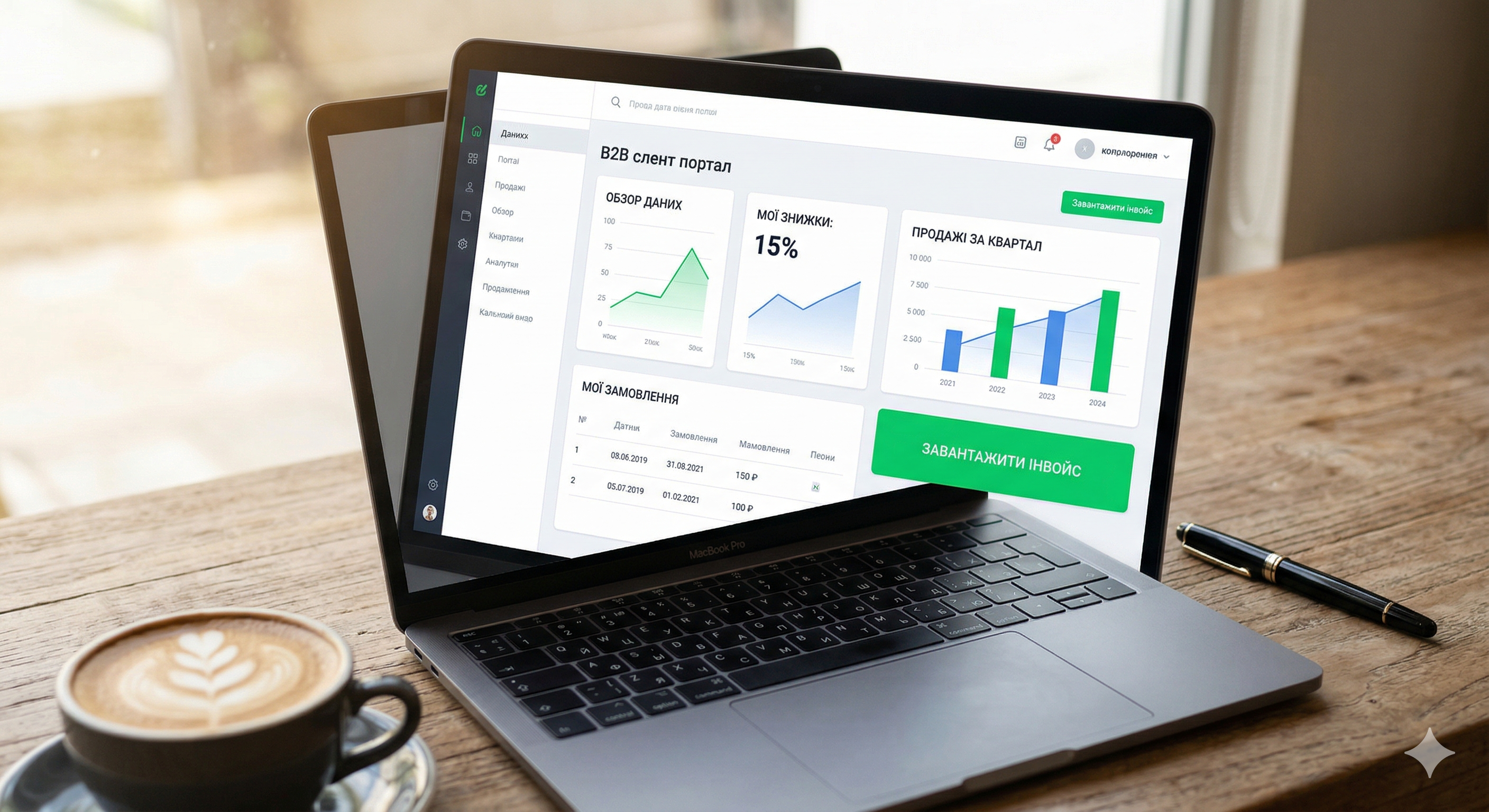
To ensure the website fulfills all the tasks described above, the correct architecture must be established during the UX/UI design phase. Here are the modules that distinguish a modern website from an outdated business card:
- Lead generation module: Dynamic contact capture forms, pop-up windows with behavioral triggers (exit-intent), call-back widgets, and integration with messaging apps (Telegram, WhatsApp).
- User account: An authorization system with different access levels (client, wholesale dealer, employee).
- Search and filtering module: Smart search with autocomplete (Elasticsearch) and complex filtering systems for service catalogs or B2B products.
- Content Management System (CMS): A user-friendly admin panel (e.g., optimized WordPress or a custom solution) that allows your marketer to publish news in 5 minutes without any coding knowledge.
- Advanced security: Extended Validation (EV) SSL certificates, protection against DDoS attacks, regular database backups, and GDPR compliance (if you operate in the EU market).
Stages of corporate website development at FullPage
Creating a large-scale web project is an engineering process that leaves no room for chaos. We follow a clear Agile methodology, ensuring transparency at every stage.

Step 1. Discovery Phase (Business Analysis and Briefing)
The most important stage. We don’t start designing until we understand your business. We conduct in-depth interviews with your top managers, analyze competitors, identify the target audience, and build a Customer Journey Map. The result of this stage is a detailed Technical Specification (TS).
Step 2. Designing the UX Architecture
We create a sitemap and black-and-white interactive wireframes. You’ll be able to “click through” the future website, check the navigation logic and block layout even before we add your brand colors.
Step 3. UI Design That Showcases Expertise
Based on your brand book, our UI designers create a unique visual style. We develop a design system (UI Kit)—a set of all buttons, fonts, and icons. Special attention is paid to the Mobile First approach—the site will look flawless on any smartphone screen.
Step 4. Programming (Frontend and Backend)
Mockups are transformed into a live product. Frontend developers are responsible for smooth animations, loading speed, and cross-browser compatibility. Backend specialists configure the server-side, databases, and implement all complex API integrations (with CRM, 1C, and payment gateways).
Step 5. QA Testing and Analytics Integration
The testing department checks the site for hundreds of possible errors (bugs): from form functionality to load testing (how the site handles 10,000 concurrent visitors). Next, we set up Google Analytics 4 and Google Tag Manager, configure basic SEO meta tags, and deploy the project to your live domain.
How much does development cost and why is it an investment
The question of cost is always individual. The price of a corporate website depends on the technology stack (whether it’s WordPress with deep customization or complex development on Laravel/React frameworks), the number of unique page layouts, and the complexity of integrations.
Creating a high-quality corporate website takes 2 to 6 months of work by an entire team (Project Manager, Business Analyst, UX/UI Designer, Frontend and Backend Developers, QA Engineer, SEO Specialist). This is a significant investment, but it has a clear ROI (return on investment). By automating processes, reducing the cost of lead acquisition, and strengthening the HR brand, a company often recoups the development costs within the first 6–10 months after launch.
Checklist for business owners before starting development
Before reaching out to a digital agency, prepare answers to these basic questions. This will save you dozens of hours during the briefing phase:
- What is the main goal of the website? (Lead generation, reducing support workload, finding dealers, brand image).
- Who are our main online competitors, and what do we like/dislike about them?
- What systems are we currently using, and what should the website be integrated with (CRM, accounting systems, email marketing services)?
- Do we have an up-to-date logo, brand book, and high-quality photo content (office photos, team photos, production photos)?
- Who on our side will make decisions and approve development milestones?
Ready to turn your website into a powerful business asset?
Your business is scaling, but your digital presence remains a “bottleneck” that loses potential B2B partners and talented employees to competitors every day. The lack of automation and modern UX design is eating into your profits.

The experts at FullPage.agency specialize in developing high-traffic corporate solutions. We’ll conduct an in-depth business analysis of your processes and create a web resource that automates sales, strengthens your HR brand, and becomes your primary lead generation tool for the next 5–7 years.
Discuss corporate website development
Read more about how we at FullPage build processes in our A-to-Z Guide to Website Creation.