Are you looking for a way to quickly make yourself known online but aren't ready to invest thousands of dollars in a complex multi-page portal? A business card website is the perfect compromise. Find out how the right approach to developing a micro-resource allows you to outperform competitors in local search, automate the collection of applications, and create a premium image of your brand in just 3 pages.
Do you think a landing page is a cheap, outdated format that doesn’t generate actual sales? Modern microsites with well-thought-out UX design and load times of under 1 second can generate leads more effectively than complex corporate portals. Below, we’ll discuss who this format is ideal for.
Why cheap business card websites ruin your brand’s reputation
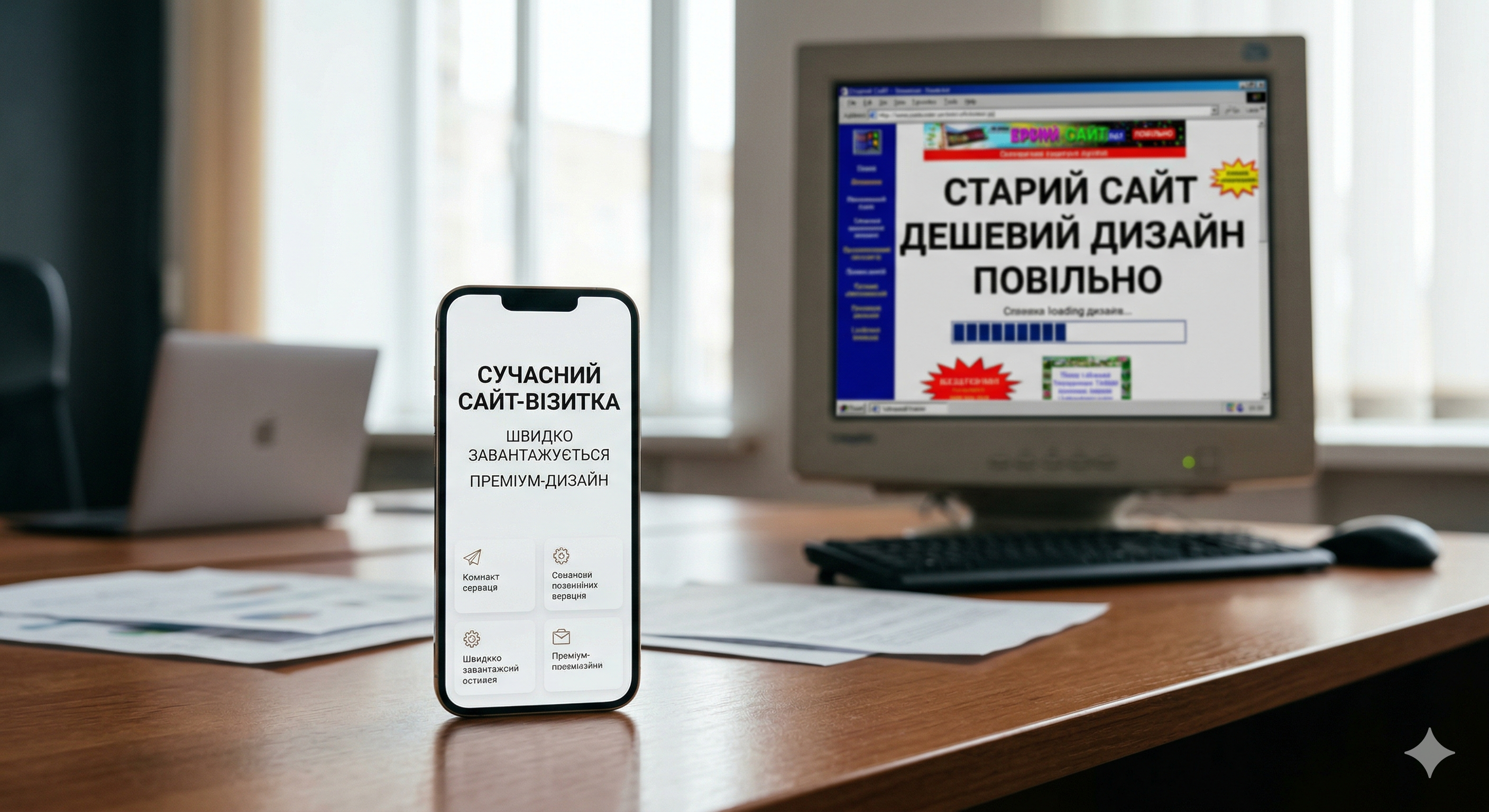
There’s a dangerous stereotype: if a company is small or a service is local, then a website can be thrown together “on the fly” for a few dozen dollars. Business owners order template solutions on free website builders, end up with a site that takes 8 seconds to load, has a clunky mobile version, and a design straight out of 2010.
What happens next? You run an ad on Google or Meta. A user clicks, goes to the site, and… closes it immediately. In the digital world, you have exactly 3 seconds to make a first impression. If your business card website looks cheap, the customer subconsciously applies that assessment to the quality of your services. They think: “If they skimped on their own image, they’ll skimp on my order too.”
Today, a microsite shouldn’t just be an informational brochure—it should be a high-converting marketing tool that loads quickly, looks perfect on a smartphone, and instantly responds to the user’s query.
What Is a Modern Business Card Website: Debunking the Myths
A business card website is a compact web resource (usually 1 to 5 pages) whose main goal is to provide basic yet comprehensive information about a company, a specialist, or a service, and to convert a visitor into a lead (a call, a request, or a message in a messenger).
Unlike complex e-commerce sites or corporate portals, a business card site does not have complex multi-level catalogs, personal accounts, or integrations with ERP systems. Its strength lies in its focus, speed, and conciseness.
Who is this website format ideal for?

Creating a business card website is a strategically sound choice for several business categories:
- Service sector and local businesses: Law firms, dental offices, auto repair shops, beauty salons, cleaning companies. Clients don’t need to read a 20-year company history—they need prices, an address, reviews, and a “Book Now” button.
- Personal brands and independent professionals: Lawyers, psychologists, business coaches, photographers, financial advisors. A website serves as a powerful tool for building trust and showcasing your expertise.
- Startups and niche testing: When you’re launching a new product (MVP) and need to quickly drive traffic to test demand without spending six months developing a complex website.
- Niche B2B companies: Manufacturers of a single specific product or companies providing a single key service (e.g., heavy equipment rental).
Business Card, Landing Page, or Corporate Website: Which to Choose?
To ensure you don’t waste your budget on the wrong format, let’s compare the three most popular types of web resources. This will help you make a decision based on data, not guesswork.
| Criterion | Business Card Website | Landing Page | Corporate Website |
|---|---|---|---|
| Scope | 1–5 pages (Home, Services, About Us, Contact). | Just 1 long page (landing page). | 10 to 1,000+ pages (blog, news, branches). |
| Main objective | Company presentation + lead generation. | Aggressive sales of a single specific offer. | Brand image, complex B2B interactions, process automation. |
| Navigation | Classic menu with page transitions. | Anchor links (scrolling down a single page). | Multi-level menus, smart search, filters. |
| SEO | Possible for local and niche queries. | Almost impossible (promoted only through paid advertising). | Maximum potential for capturing a niche on Google. |
Conclusion: If you’re selling a single course or conference tickets, you need a landing page. If you have a factory with a dealer network, you need a corporate website. If you’re a law firm or dental practice that needs a solid online presence to accept requests, order a business card website.
The Anatomy of High Conversion: Essential Elements of a Business Card Website
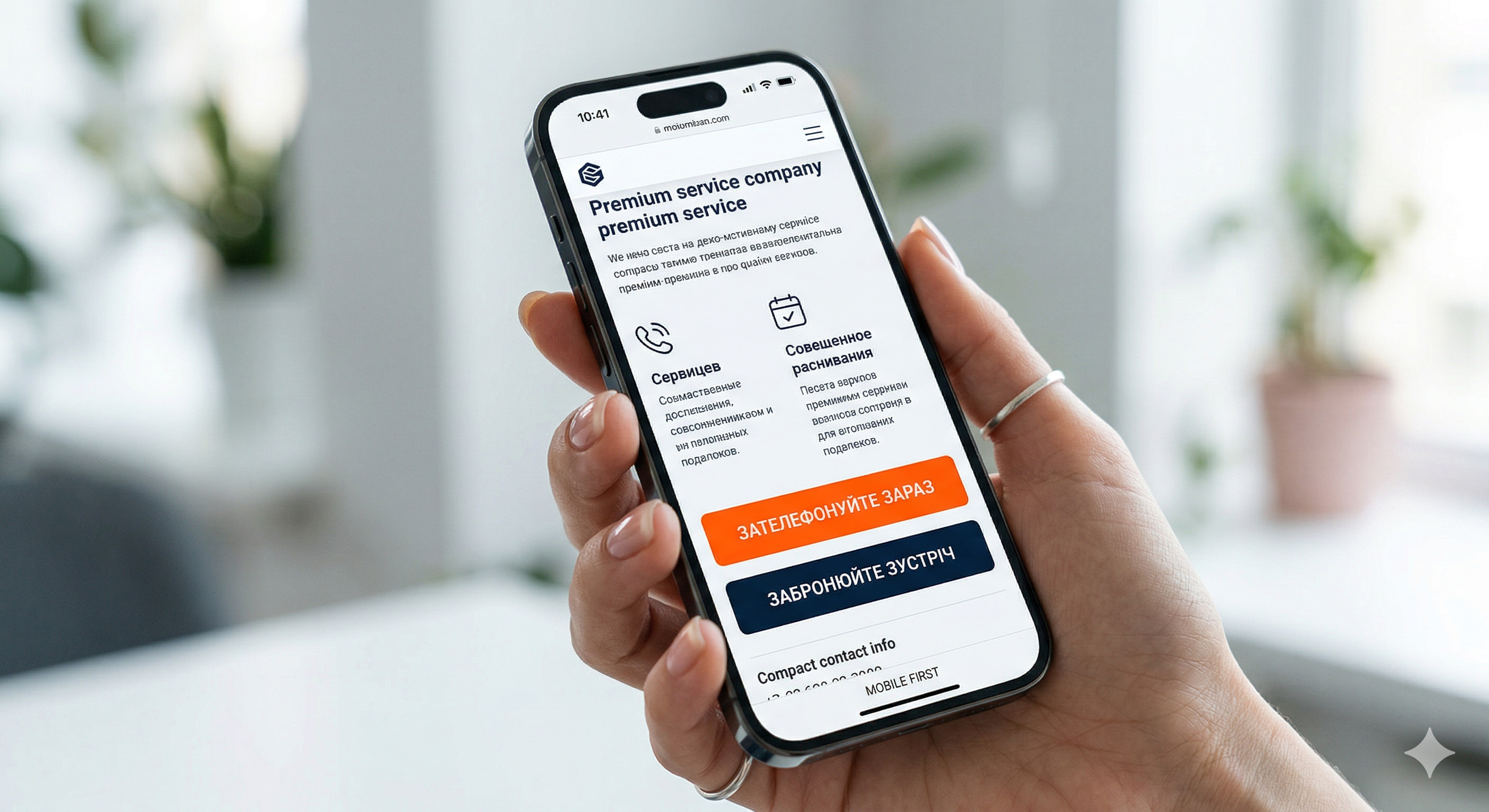
For a business card website to function as your best sales manager, its UX/UI design must be built according to the principles of neuromarketing and the AIDA/PAS formulas. Here’s what a modern microsite must include.
1. The First Screen (USP) — The 3-Second Rule
The user must instantly understand: where they’ve landed, what’s being offered, and why it’s beneficial. No abstract phrases like “We make the world a better place.” Just specifics: “Coffee machine repair in Kyiv with on-site service in 30 minutes. 1-year warranty.” There should also be a contrasting CTA (Call to Action) button here — “Call a Technician” or “Get a Consultation.”
2. Services section and transparent pricing
Most customers hate phrases like “price upon request” or “call for details.” Today’s audience values their time. Even if your services have custom pricing, provide a price range (“starting at $500”) or include an interactive calculator. This will filter out non-targeted leads and build trust.
3. Social proof and trust triggers
On the internet, people buy from people. To address objections, your business card website should include:
- Real photos of your team or office (no stock photos of people in suits!).
- Case studies in the “Problem → Solution → Results in Numbers” format.
- Testimonials with links to clients’ social media profiles or integrated reviews from Google My Business.
- Your company’s licenses, certificates, and awards.
4. Seamless contact information
A business card website is created for the purpose of making contact. Include clickable phone numbers (so users can call with one tap from their mobile), active links to messaging apps (Telegram, Viber, WhatsApp), and an interactive Google Maps map for local businesses. The contact form should be short (Name, Phone — that’s enough).
Is it possible to promote a business card website on Google (SEO)?
There is a myth that business card websites are not indexed or ranked. This is not true. Although a microsite cannot compete with giants like marketplaces for high-frequency queries (e.g., “buy a laptop”), it has enormous potential in local SEO.
How we at FullPage set up SEO promotion for such projects:
- Semantic Core: We collect location-based and low-volume commercial queries (e.g., “notary in Pechersk prices,” “suspension repair in Dnipro”).
- Speed optimization: Lightweight code and modern image formats (WebP) ensure the site loads within the “green zone” of Google PageSpeed Insights, which is a powerful ranking factor.
- Local factors: Mandatory Schema.org microdata (LocalBusiness) and integration with Google Business Profile. Your business card will appear on Google Maps and in local search results above the main search results.
How a commercially effective business card website is developed

We don’t use clunky templates. The development process at FullPage.agency is focused on delivering results for your business:
Step 1. Briefing and marketing analysis
We study your niche and target audience and analyze the websites of your top 5 direct competitors. We identify their weaknesses (such as a lack of mobile optimization or complicated forms) and turn them into your competitive advantage.
Step 2. Design and Copywriting
Our marketers develop wireframes and write sales copy using the PAS formula (Problem → Aggravation → Solution). We don’t ask you to provide text—we create turnkey commercial content.
Step 3. UI Design and Mobile First
Over 75% of traffic today comes from smartphones. We design the interface first for mobile devices, ensuring that buttons are easy to tap with a finger and text is perfectly readable without zooming in. Only then is the design adapted for tablets and desktops.
Step 4. Technical Implementation and Integrations
Clean code layout and setup of a fast CMS (content management system) so you can update prices or photos yourself. We connect Google Analytics 4 and Meta Pixel and configure form integration with your CRM system or Telegram bot.
Mini-case study: How a business card website cut the cost per lead in half
Client: Landscape design studio.
Situation before we got involved: The client was using a landing page built on a free website builder. The cost per lead (CPL) from Google Ads was $15. Conversion rates were low (around 1.5%) because the site looked cheap and didn’t inspire confidence in a premium service.
What we did: We developed a 4-page business card website (Home, Portfolio, Pricing, Contact) with a premium minimalist design, fast loading times, and a portfolio optimized for search queries.
Result: After 2 months, the conversion rate rose to 4.2%. Thanks to proper UX and speed, the cost per lead (CPL) dropped to $7. Additionally, the site began generating 2–3 free inquiries per week from Google Maps.
Are you losing customers because you’re not online?
Your competitors are already capturing the hottest traffic from Google, while customers search for your services on outdated classifieds sites or lost Instagram accounts. A poor online presence costs you reputation and real profit every day.

The experts at FullPage.agency will create a modern, fast, and high-converting business card website for you that will become your best 24/7 manager. We’ll design the structure, write sales-driven copy, and optimize the site for maximum lead generation.